


Adolf Shapiro
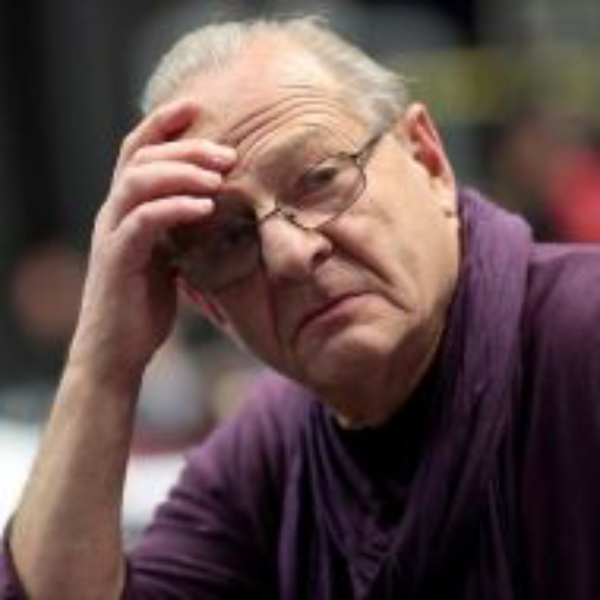
Internationally celebrated and award-winning Adolf Shapiro directed his first play at the age of 23 and immediately won high acclaim from critics and audiences. From the age of 25, and for thirty years, he was the driving force behind the Riga Youth Theatre, with its two companies, one Russian and one Latvian. After the theatre closed, in 1992, he continued as an independent director and theatre teacher. Shapiro graduated from the Kharkov I.P. Kotlyarevsky University of Arts and furthered his studies at the Theatre Directors’ Workshop under the guidance of the legendary teacher and director Maria Knebel (herself a student of Stanislavsky, Nemirovich-Danchenko and Mikhail Chekhov), whom he regards as his theatrical and spiritual mentor. Shapiro succeeded in her position after her death, in 1985.
Shapiro’s reputation rests largely on his interpretations of Chekhov, to whose body of work he has returned time and again in an effort to provide a thorough analysis. His work is based on the Stanislavsky method, as well as on further experiments by Brecht and other theatre reformers. Among his many acclaimed productions are Peer Gynt by Henrik Ibsen, The Prince of Homburg by Heinrich von Kleist, The Last Ones by Maxim Gorky, a number of plays by Aleksei Arbuzov, Molière by Mikhail Bulgakov, Who’s Afraid of Virginia Woolf by Edward Albee, Fear and Misery of the Third Reich by Bertolt Brecht, and Democracy! by Joseph Brodsky.
Shapiro has worked extensively abroad. His productions have been presented in many countries (Ιtaly, the former Yugoslavia, Canada, the USA, Germany, Colombia, Venezuela, Finland et al.). He has directed plays in Moscow (Moscow Art Theatre, Vakhtangov Theatre, Et Cetera Theatre, Maly Theatre, the Russian Academic Youth Theatre), St. Petersburg (Tovstonogov Bolshoi Drama Theatre), Tallinn (Estonia Drama Theatre, Norsooteater, Linnateater), Montevideo (Comedia Nacional), Tbilisi, Minsk, Caracas (Ateneo de Caracas), Tel Aviv (Gesher Theatre, Yiddishpiel), Warsaw (Ochota Theatre), and Athens, to name a few. His latest productions in Moscow include the opera Lucia de Lamermur by Gaetano Donizetti (Golden Mask award) at the Stanislavski and Nemirovich-Danchenko Moscow Academic Music Theatre, and the operetta The Merry Widow by Franz Lehar at the Stanislavsky Ballet and Opera Theatre.
As a master teacher, Shapiro maintains an ongoing relationship with the American Repertory Theater’s Institute for Advanced Theater Studies, and the Northern Illinois University’s School of Theater and Dance, and is a lecturer at the Stanislavsky Summer School in USA (Boston), the Harvard Program. He also maintains a partnership with ENSATT (Lyon), where he teaches directing and acting. He was one of the workshop leaders at Methodika (Venice, Italy), has run a workshop in the National Theatre, Munich, and has taught in Italy, Poland, Colombia, and other countries.
Several generations of students have graduated under his guidance as a professor at the Riga Conservatory, many of them becoming leading stage and film actors. Shapiro has also run workshops at his theatre, attended by a considerable number of foreign directors and set designers. He has an honorary doctorate from the Theatre Academy in Tallinn, Estonia, where he teaches practical classes twice a year. In 2011, he was elected an honorary doctor of the Shanghai Theatre Academy.
Adolf Shapiro has won many awards, both in Latvia and abroad, including the 2006 International Stanislavsky Award. In 2003 he was granted the Order of the Cross of Terra Mariana for his contribution to the development of the Estonian culture, while in 2011 he was awarded the top Latvian Order of Three Stars for his contribution to the Latvian culture, as well as the Russian Order of Friendship.
He writes regularly for newspapers and theatre journals and has published two books, Entr’acteand the award-winning When the Curtain Falls, which focus on acting and directing.
Workshop
Ancient Drama: From Text to Stage
This workshop has a theoretical and a practical part.
The theoretical part is devoted to the analysis of ancient texts, the exploration of the political situation, the emergence of theatre and the philosophical thought that gave birth to these unique works. The fact that all these elements applied to the particularities of ancient dramaturgy, as well as to that scenic construction that became historically known as “The Theater of Ancient Greece”. Sophocles’ Antigone has been chosen as the main working material. Using the structure and the textual content of the play we will examine the possible ways of incarnating the text on stage using the experience of contemporary theatre. The aim is to discover the timeliness of the issues Sophocles’ was preoccupied with and their relationship with those the world faces today.
The second part of the workshop consists of acting exercises devoted to the issues of: “The Actor and Space”, “The Actor and Speech”, “The Actor and the Character”, as main elements of acting in both the ancient and contemporary theatre. Its main objective though is the rehearsal of scenes from Antigone, so that the theoretical part of the workshop can merge with the practical one.